
Why’s Everyone Talking About Redistricting?
In this edition of TPO Explains, we break down congressional redistricting, explaining how states redraw voting maps, why gerrymandering is controversial, and why some states are trying to redraw districts before the next census.
Why’s Everyone Talking About Redistricting?
Why’s everyone talking about congressional redistricting?
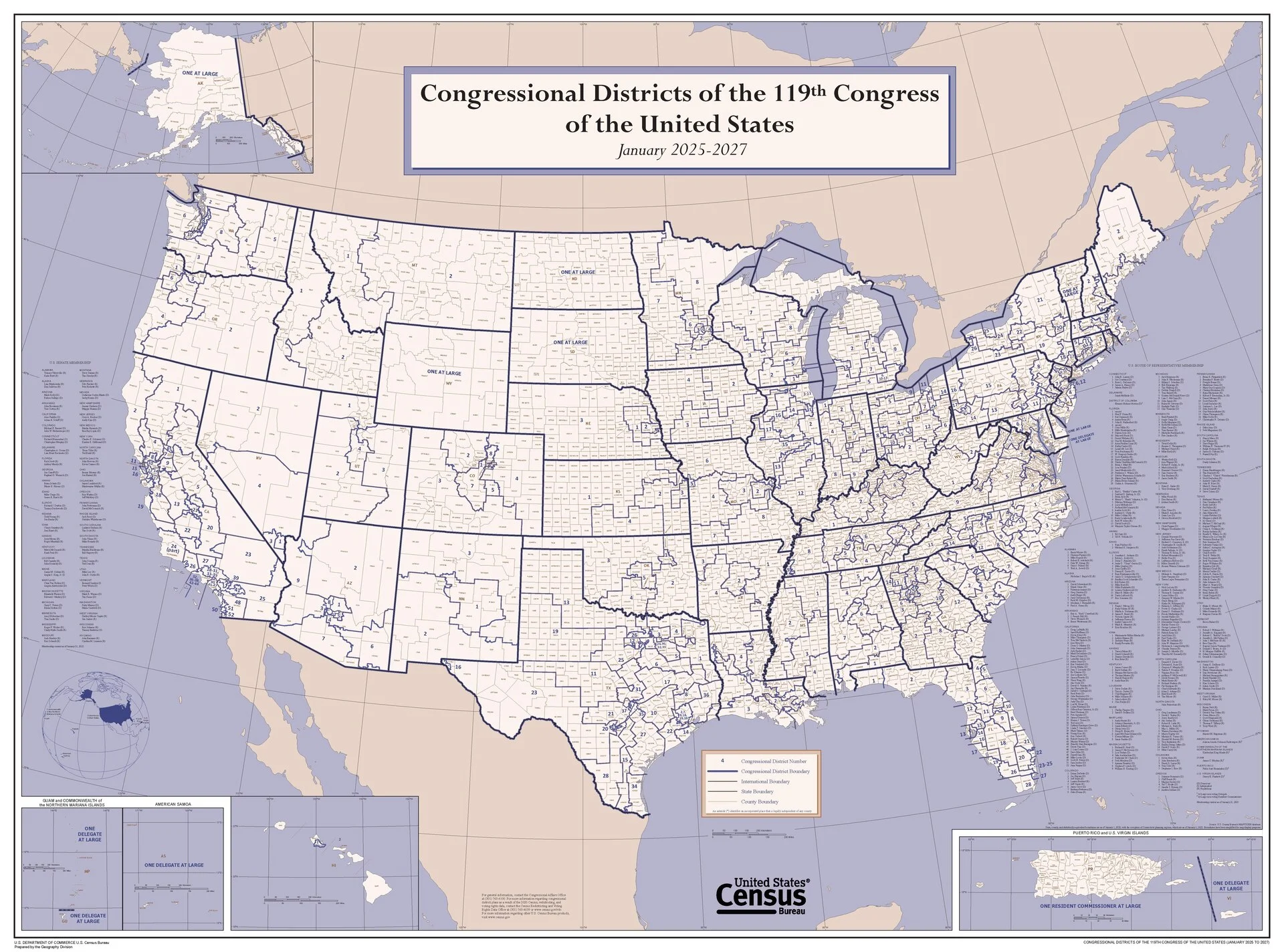
Redistricting is a big adult coloring book the process of drawing state maps to determine Congressional districts. Let’s back up.
Lawmakers—most notably House Representatives—are elected by voters grouped into districts. Population determines the number of districts in a state (ex: Wyoming has more cows than people, so they get one district vs. California’s 39.5M people and 52 districts).
There can only be 435 Reps in the House, but populations change… so, every ten years, states redraw district boundary lines based on the census to make sure the demographics make for a fair voting landscape.
Wait, but we’re redistricting mid-decade?
Some states are (or are trying), yes.
Midterm election season has sparked an unprecedented race to redistrict early. Texas, Ohio, North Carolina, Utah, California, Missouri, Florida, and Virginia have all mocked-up new maps (some of which are tangled in court challenges). The hope is that by moving voters around, lawmakers can give one political party more of an edge. That process is called salamandering gerrymandering.
Republicans currently hold a narrow 218-212 majority in the House with five vacancies, meaning if some states can redistrict strategically, they could help Republicans hold the House or Democrats swing it.
How does gerrymandering work?
There are a couple of common strats:
- Cracking: spreading a particular type of voter (eg, Republicans or Democrats) among many districts, preventing them from having a majority.
- Packing: packing a large number of similar voters together into a single district to limit their influence on other districts.
States sometimes also move things around to force incumbents into the same district (hijacking) or move an incumbent into a different district where reelection is harder (kidnapping).
Are states even allowed to do this?
Technically, yes. Partisan gerrymandering is technically not illegal, and no federal law prohibits redistricting more often than every ten years, but every state has its own rules for who’s allowed to redistrict and how (you can learn more about that in this week’s TPO Explains episode).
Several new maps are tangled up in courts right now while judges determine whether they played by the state rules.
ABOVE ALL, LOVE
During any election season, it’s easy to focus on the shortcomings of our government, opponents, or nation and cast ourselves in the right. When we find ourselves grumbling about others, we must remember to check our own hearts.
“Why do you look at the splinter in your brother’s eye but don’t notice the beam of wood in your own eye? Or how can you say to your brother, ‘Let me take the splinter out of your eye,’ and look, there’s a beam of wood in your own eye? Hypocrite! First take the beam of wood out of your eye, and then you will see clearly to take the splinter out of your brother’s eye.”
Matthew 7:3-5 (CSB) (read full passage)